Fire Assay
Gold by classical lead-collection fire assay on 30 g charges — fused, cupelled, and finished by AA, ICP, or gravimetrically. The workhorse method for exploration and grade control, with the AA finish inside the lab's ISO/IEC 17025 accredited scope.
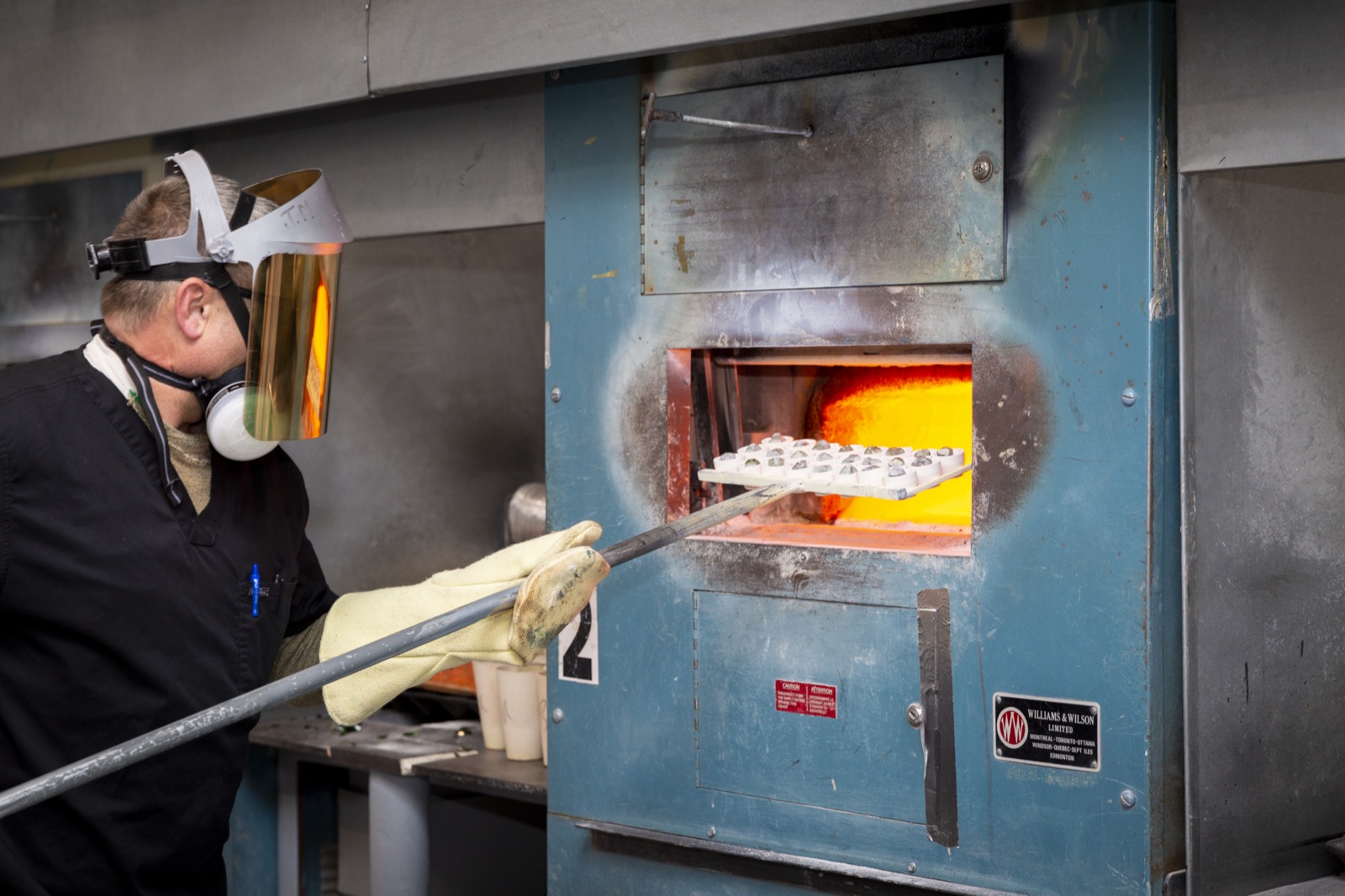
Samples are fused in batches of 24 — each batch carrying a blank and a certified reference standard — with a lead-oxide flux matched to the sample’s mineralogy. In the fusion the entire 30 g charge dissolves into molten lead, which collects the precious metals and settles to the bottom of the melt. The lead button is separated from the slag and cupelled in a second furnace, where the lead oxidizes away to leave a silver doré bead carrying the gold.
The bead is parted in nitric acid to take up the silver, then hydrochloric acid is added to form aqua regia — one of the few reagents that dissolves gold. The solution is made to volume and read by atomic absorption. A gravimetric finish, where the gold is weighed directly on a microbalance, is available for high-grade material, and a gold–platinum–palladium suite with ICP finish covers PGE work.
Because the whole charge is consumed in the fusion, fire assay measures total gold regardless of how it is held in the rock. Where gold is coarse or nuggety and a single 30 g charge may not represent the sample, total pulp metallics screening is the better tool.
Fire assay finishes
| Finish | Elements | Detection limit | Upper limit | Digestion & finish | Charge |
|---|---|---|---|---|---|
| AA | Au | 5 ppb | — | Lead fusion → aqua regia → AAS | 30 g |
| ICP | Au, Pt, Pd | Au 3 ppb | 2,500 ppb | Lead fusion → ICP-OES | 30 g |
| Gravimetric | Au | — | — | Lead fusion → doré bead weighed | 30 g |
The lower detection limit for the AA finish is 5 ppb. Per-element upper bounds are not published for the AA and gravimetric finishes.