Sample Preparation
Drying, crushing, splitting, and pulverizing for rock, core, soils, tills, and sediments — with documented cleaning between clients to control carry-over.
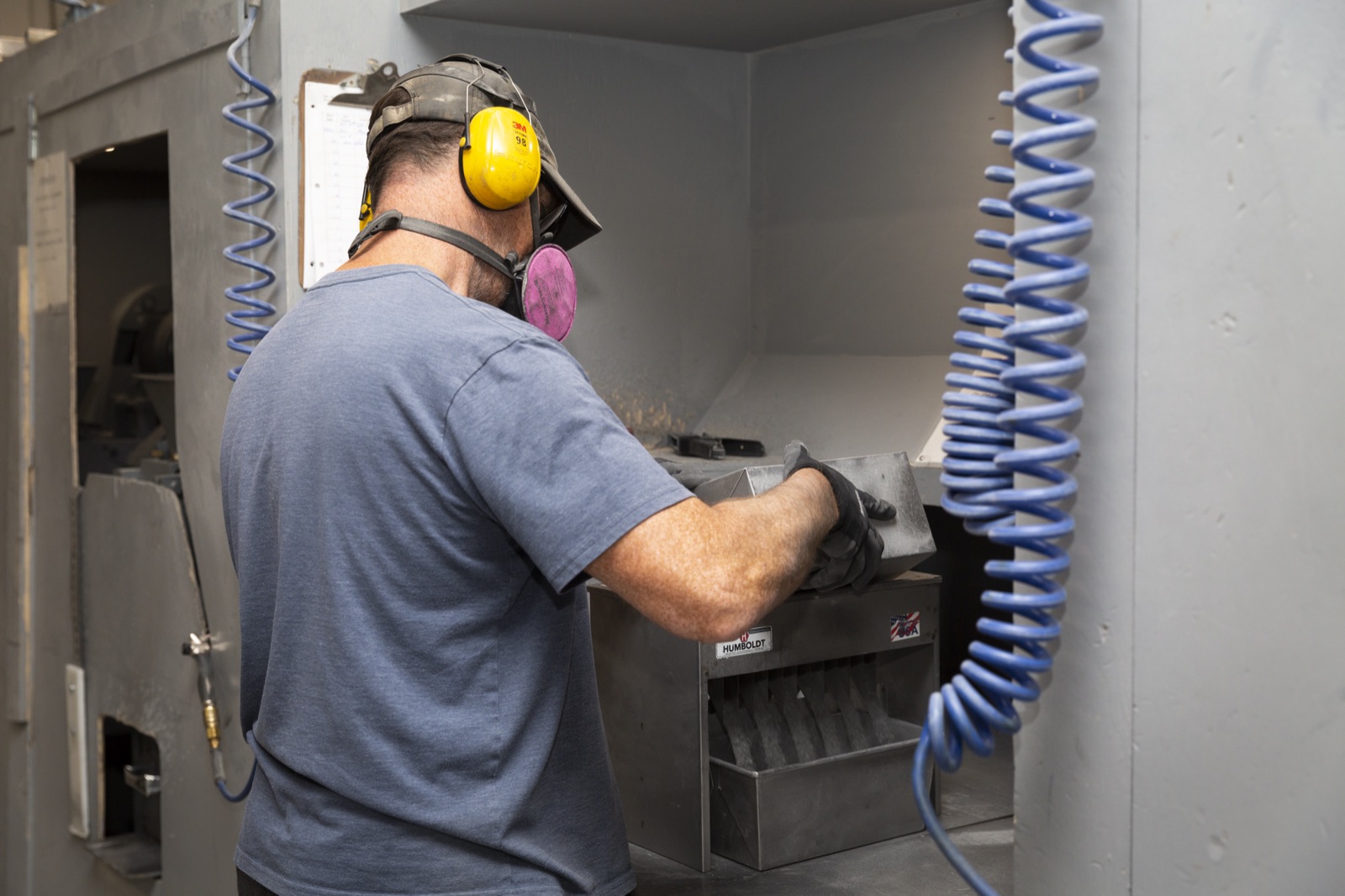
Rock and core samples are logged against the submittal form, dried at about 60 °C, and jaw-crushed to roughly 80 % passing 10 mesh. The full crushed sample is riffle-split to a ~250 g subsample and the remainder is bagged and stored as coarse reject. The split is pulverized to approximately 95 % passing 150 mesh — the pulp that all downstream assays draw from.
Crushers and pulverizers are cleaned between clients, and between samples where the material warrants it; flagging high-grade samples on the submittal form helps the lab sequence work to keep carry-over risk down. Soils, tills, and stream and lake sediments are dried and sieved or pulverized to spec, and heavy mineral concentrates are handled to order. Prep-only service is available for samples analysed elsewhere, and pulps and rejects are stored after analysis so follow-up work can start from the same material.
Preparation by matrix
| Matrix | Preparation | Typical intake |
|---|---|---|
| Rock & drill core | Crush to 80% −10 mesh, split ~250 g, pulverize to 95% −150 mesh | up to 3 kg |
| Soils & silts | Dry at 60 °C, sieve to −80 mesh (or pulverize to −100 mesh) | initial 500 g |
| Tills & streams | Dry at 60 °C, sieve to −80 mesh or pulverize to −150 mesh | initial 500 g |
| Lake sediments | Dry at 60 °C, sieve to −80 mesh | initial 500 g |
| Heavy mineral concentrates | Dry at 60 °C, transfer to envelope (or pulverize to −100 mesh) | per 250 g |
| Metallic sieve | Crush, pulverize, sieve to −150 or −200 mesh, save fractions | first 1 kg |
Rock and drill core is the highest-volume preparation. Procedures are matched to the sample matrix.